EVENT
6-7 November 2025
Convene, Bishopgate, London
Starting the day with purpose and honesty
Walking into the BMJ Future Health conference felt energising from the start. The opening remarks set a clear tone: this event was not about showcasing shiny tech solutions but about understanding the real problems facing health and care today. Dr Kamran Abbasi, Editor-in-Chief of the BMJ, put it perfectly by reminding us of Einstein’s quote – if he had an hour to solve a problem, he’d spend 55 minutes understanding it, and only five on the solution. That mindset carried through the entire morning.
Dr Abbasi also spoke openly about something many of us feel but don’t always say: in the rush to adopt digital tools and AI, the voices of patients and health professionals are often sidelined. His emphasis on BMJ values – being evidence-based, patient-centred, transparent, courageous, and people-first – was a grounding reminder of the purpose behind innovation.
A five-star panel to open the conversation
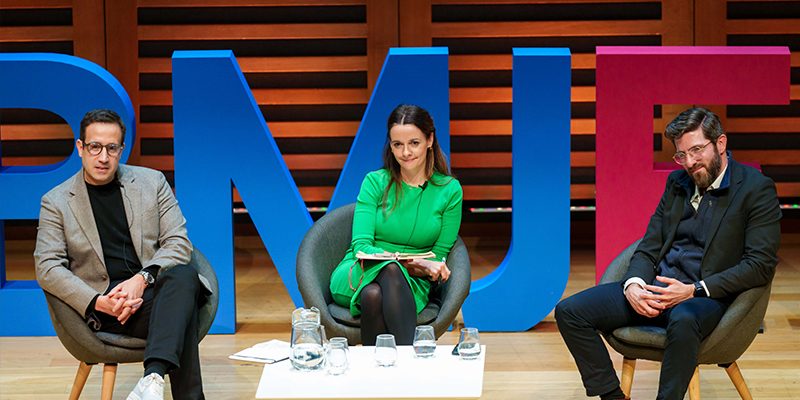
The first panel, “The vision for a digital future for healthcare,” brought together a diverse group of leaders:
• Rosalind Campion, CEO of the Academy of Medical Sciences
• Ben Maruthappu, Founder and CEO of Cera
• Olivia Burns, Founder and Innovation Consultant at Hyoplas
• Chaired by Jenny Jones (UCL)
What struck me most was how aligned they all were – yet from completely different angles.
Rosalind spoke candidly about her experience developing the Government’s digital health plan. Despite the political complexity, she said there is “remarkable consensus” across patients, clinicians, and industry that digital transformation is inevitable. The deeper issue, though, is our system’s impatience – everyone wants rapid progress, but also wants their own immediate frustrations fixed at the same time. Her reflection on the tension between long-term transformation and short-term demands was one of the most honest contributions of the morning.
Ben brought the reality of community care to life through his personal story of caring for his mother. His insights on misaligned incentives – especially the way social care is still reimbursed by “minutes of care” – highlighted how outdated structures hold back genuine innovation. His warning was powerful: technology can only go so far if the system it enters hasn’t evolved.
Olivia’s contribution was deeply moving. As one of the oldest survivors of hypoplastic left heart syndrome in Europe, her life story is itself a testament to what innovation can achieve. But she challenged the audience directly, “if you don’t ask patients what they need before you design the technology, why are you surprised when they don’t use it?” Her message about respecting patients as equal partners – not tokens – was one of the clearest calls to action of the entire panel.
Setting the tone for the days ahead
Between Jenny’s facilitation and the panel’s honesty, the session showed a theme that came up repeatedly: Digital transformation will only work if it is co-designed, aligned with real-world workflows, and centred around people – patients and staff.
This opening session set a strong foundation for the rest of the conference, and it was refreshing to see such alignment between leaders from policy, industry, community care, and patient advocacy. It felt like the right conversation at exactly the right moment. After the opening keynote, I joined the breakout session “How to Build Health Tech From the Frontline,” led by Randeep Sidhu, Non-Executive Director at NHS Business Services Authority and former Director at Babylon and NHS COVID-19 App lead.
At first, I wondered if it was the wrong choice for someone representing Future Nurse, but it quickly became the most relevant session I could have attended. Randeep broke down how clinical problems become digital products in a way that directly linked to the work we do in Future Nurse. He explained that clinicians often know the problem deeply but struggle to communicate it in a way product teams can use. His “house-building” analogy – clinicians as the people who live in the house, product managers as the architects, engineers as the builders – made it clear why nurses need more digital confidence, not coding skills. This mirrors Future Nurse’s core message: Nurses must be able to articulate the problem clearly or someone else will design the solution for us.
A key insight for me was his reminder that the communication style we use in clinical environments (command and control) does not work in tech teams. Digital innovation depends on collaboration, flexibility, and being open to refining ideas rather than defending them. That challenged me in a healthy way – it made me more aware of how easily clinicians can be misunderstood in tech spaces.
Sidhu also highlighted barriers within the NHS, including the “thousand flowers bloom” problem where innovations start but rarely scale due to procurement hurdles. This reinforced why Future Nurse’s focus on a digitally confident workforce is essential: solutions cannot scale if the workforce isn’t equipped to adopt them.
Overall, this session helped me understand how nurses can influence digital innovation, not by building the tech themselves but by communicating problems clearly, partnering well with tech teams, and shaping early design decisions. It clarified why Future Nurse exists – and why our role in digital transformation is both urgent and possible.
From frustration to innovation
Another break out session I attended was, “From Frustration to Innovation: Why Early-Career Professionals are Essential in Leading A Digital Health Revolution. ,” echoed many of the themes Alice McGee highlighted in her reflections on equitable digital health: that innovation must reduce – not reinforce – inequalities, and that early-career professionals play a crucial role in shaping that future. The session reframed frustration as a form of insight, showing how those of us closest to frontline challenges are often best placed to identify where digital solutions can genuinely make care fairer and more responsive. What struck me most was the emphasis on early-career voices not as “future leaders,” but as current drivers of change whose lived experience can bridge the gap between patient needs and technological design. This message tied together the core lesson I took from the different break out rooms I attended through out the day: meaningful digital transformation will only happen when diverse, frontline perspectives actively shape the tools and systems we build.
Reviewer – Freda Donkor, Advisory Board Member, Future Nurse
With thanks to – The BMJ and The Burdett Trust for arranging tickets


Stay up to date …
Follow us on Linkedin: Future Nurse Community
Subscribe to our newsletter: Future Nurse Notes
Listen to our podcast: Future Nurse Notes LIVE!